Understanding Legal Accountability in Influencer Marketing and Consumer Protection in India
Ananya Aggarawal
College- KCC Institute of legal and higher education affiliated with GGSIPU
Editor-Subhra Dan
INTRODUCTION
Influencer marketing has gained traction and become an essential tool of digital economy, especially in India with its 800 million internet users. Influencers on Instagram, YouTube, and Twitter are not just content creators, but often consulted and trusted sources that shape public opinion and consumer behavior. However, with great power comes great responsibility. Many influencers endorse products and services without truly disclosing payments when engaging in paid partnerships, resulting in misleading conclusions for consumers. In India, this raised regulatory concerns, especially when influencers endorse products and services that led to loss of money or harm to the consumer. The existing law in India provides a mix bag of statutory provisions and guidelines for self-regulation. The article will explore potential legal frameworks that regulate influencer marketing in India. The article will address the challenge of regulation and enforcement and suggest reforms where necessary to better regulate influencer marketing, compliance and provide consumer protection.
THE RISE OF INFLUENCER ECONOMY IN INDIA
In 2023, India's influencer market had a worth of more than INR 1,200 crore and is expected to surpass INR 2,200 crore by 2025. The changing trend in consumer trust, moving from global celebrities to digital creators, is notable in the increasing number of brand collaborations with influencers of all types and sizes -- mega, macro, micro, and nano.
Influencers often demonstrate a product with product reviews, tutorials, unboxing, or testimonials personally sharing a product experience, thus adding uncertainly to whether this constitutes an opinion or a promotion. Consumers have difficulty discerning someone's subjective opinion from a post that communicates a paid collaboration even more so, if there is no disclosure, or a lack of clarity on the rules for disclosures.
APPLICABLE INDIAN LEGAL FRAMEWORK
There are many overlaps with legislation and various regulations surrounding influencer marketing in India:
· Consumer Protection Act, 2019: The Consumer Protection Act, 2019 defines a 'misleading advertisement' under Section 2(28) and empowers the Central Consumer Protection Authority (CCPA) to penalize individuals responsible for false or misleading endorsements. Penalties range from ₹10 lakhs in fines and even imprisonment, in extreme cases.
· Consumer Protection (E-Commerce) Rules, 2020: It is to be noted that the Consumer Protection (E-Commerce) Rules, 2020 covers any e-commerce platforms or their affiliates, like influencers, and requires to be clear and transparent.
· ASCI Guidelines for Influencer Advertising in Digital Media (2021): In this guideline influencers are required to disclose paid content using labels such as #ad, #sponsored, #collab... they also must be upfront with the disclosures and easily seen.
· Information Technology Act, 2000: Section 79 states intermediaries are liable when notified of unlawful content and do not take it down.
While the ASCI guidelines are self-regulatory in nature they are frequently being referenced and cited by courts and regulators as an industry standard.
LEGAL ACCOUNTABILITY OF INFLUENCERS IN INDIA
Social media influencers are effectively marketing agents whose power has significantly grown alongside the proliferation of digital media. The problematic growth of influencers in social media, and the lack of distinction between personal opinion and a paid endorsement, created undeniable issues of misleading advertisements. Hence, India has slowly moved in the direction of holding influencers legally responsible for their content claims that can directly affect consumer interests.
A landmark shift for this area of commerce came with the passage of the Consumer Protection Act, 2019. This Act gave the Central Consumer Protection Authority (CCPA) with the authority to act on misleading advertisements, including acts by influencers. Anyone promoting products or services, such as influencers without adequately disclosing paid brand partnership may incur improper advertising fines of up to ₹10 lakhs for the first offense and ₹50 lakhs for repeat offenses. Endorsers are also liable to fines via due diligence from influencers before product promotion.
In January 2023, the Department of Consumer Affairs provided explicit ethical guidelines titled “Endorsements Know-hows!” that focused on the particularities of social media influencers. The guidelines specify they must also disclose any material connection including paid collaborations, gifts or monetary benefit with forms of communication like #ad, #sponsored, or #paidpartnership for clear and prominently described communication. The guidelines were designed to ensure transparency and protect consumers from misleading marketing claims.
In addition, The Advertising Standards Council of India (ASCI) plays an important role in regulating influencer marketing. Part of ASCI's self-regulation system sets out a framework of guidance designed to encourage truthfulness, ethical responsibility, and disclosure in digital advertising.
ROLE OF BRANDS AND ADVERTISING AGENCIES
In India's evolving influencer marketing landscape, brands and advertising agencies are important players in the ecosystem—not just as the elements creating promotional materials, but also in upholding the principles of advertising law and making sure about ethical advertising practices. This absence of a distinction between organic content and paid promotion through social media influencers caught the attention of regulatory bodies like the Advertising Standards Council of India (ASCI) and Central Consumer Protection Authority (CCPA) and this has led to rules providing more explicit guidance.
According to the ASCI Guidelines for Influencer Advertising in Digital Media (2021) and the Consumer Protection (E-Commerce) Rules, 2020, it is not only the responsibility of the influencer to make sure sponsored content is clearly disclosed. Brands and their agencies have a responsibility to make sure that sponsored content must at all times be labelled as sponsored content and/or be expressly disclosed as in a #ad or #sponsored way that is clear and not misleading.
Advertising agencies typically serve as intermediaries between brands and influencers, providing campaign management, negotiating terms, and tracking content. Agencies often find themselves in a position of co-responsibility. Agencies, like influencers and brands, also have a sense of due diligence. They are expected to approve the content for compliance with regulations before it is posted. If they don't approve the content, and the credibility is impaired due to non-compliance, the agency may also face reputational effects, or even legal consequences, not to mention consumer complaints for unfair advertising pursuant to the provisions of the Consumer Protection Act, 2019, that concern misleading advertisements.
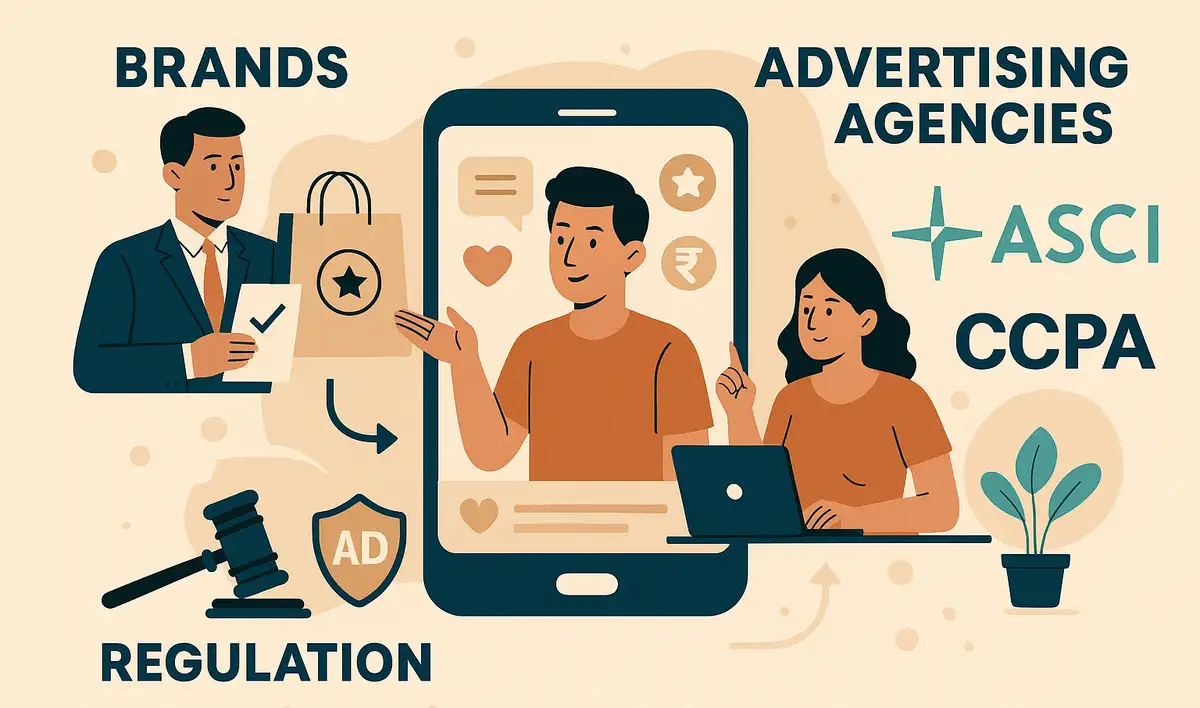
In addition to placing responsibility on the agency, the brand cannot simply point fingers at the influencer. When it comes to false or misleading representations made in influencer posts, both the brand and the agency could, and likely would be, held legally liable for damages. This means that all parties must remain diligent, seek clarity on contractual obligations, and only engage in ethical advertising practices.
CHALLENGES IN ENFORCEMENT
While Indian agencies would take various satisfactory steps to regulate influencer marketing through guidelines issued by the Advertising Standards Council of India (ASCI) and through provisions under the recently enacted Consumer Protection Act, 2019, one of the greatest impediments will, of course, be enforcement.
One substantial challenge is a lack of awareness and clarity as it pertains to the rules, regulations, and disclosures needed for influencers, especially micro and nano influencers. Many of these influencers don’t even know the disclosure norms exist or understand the legal implications of ignoring a disclosure, meaning there is often inconsistent implementations of ad labelling because even guidelines demand a clear disclosure (#ad or #sponsored etc.)
Another hurdle to enforcement is the nature of digital content and all of the available platforms through which influencer marketing occurs. Influencers often create content on platforms like Instagram, YouTube, or Twitter, where content is consumed and created at an incredibly fast pace. When influencers fail to comply with regulation, government agencies may be unable to monitor and take any action in real-time, making the regulation of influencer marketing and verification of each influencer possible only after the fact, if it is achievable at all.
Jurisdictional issues complicate enforcement. Since influencers frequently operate in international jurisdictions, and brands may engage with different content creators in those jurisdictions, enforcing Indian legal principles becomes challenging due to cross-border legal limitations.
Enforcement is also in development. While ASCI, an industry self-regulatory organization, may issue warnings or ask for takedowns of content with public complaints, they can only provide advisories or resolve matters by asking a content creator to take down and cease using content. CCPA has much more authority, but they are still building the digital and administrative capacity for enforcement of influencer complaints.
CONCLUSION
When carried out appropriately, influencer marketing can be a tremendous opportunity for brands to build a brand identity and connect consumers. Without regulation, though, unregulated endorsements will erode public confidence and endanger the well-being of vulnerable consumers. Indian law is slowly catching up with the realities of influencer marketing as the law evolves, but loopholes in enforcement persist that expose viewers to malicious marketing practices.
India can leverage the unprecedented win-win imagery of consumer protection and innovation by giving power to regulators, guiding influencers, and holding the brand responsible. In a market in which digital influence is money, transparency has to be the standard and the measure.
RECOMMENDATIONS & THE WAY FORWARD
The following reforms are recommended to promote consumer protection and compliance:
1. Statutory backing to ASCI guidelines: ASCI guidelines are to be made enforceable by law through necessary notifications or parliament project work.
2. Mandatory influencer registration: A verified database of commercial influencers must exist, to track compliance of actual influencers versus fake influencers.
3. Digital literacy campaigns: Programs to train influencers on consumer protection laws and ethical duties of advertising.
4. Compliance of vernacular content with national guidelines: Regional language disclosures should adhere to national guidelines and hence, influence communications.
5. Grievance redressal platforms: Establishing a consumer platform to ensure that a grievance could be filed against a known deceptive endorsement should be an expedited and streamlined process.
A join and cooperative responsibility should be established between the businesses, government, the brands, platforms and advertisers to foster a safe digital marketplace.
REFERNCES/ CITATIONS
1. Consumer Protection Act, No. 35 of 2019, § 2(28), INDIA CODE (2019).
2. The Consumer Protection (E-Commerce) Rules, 2020, MINISTRY OF CONSUMER AFFAIRS, FOOD AND PUBLIC DISTRIBUTION, available at https://consumeraffairs.nic.in/sites/default/files/Ecommerce_rules.pdf.
3. ADVERTISING STANDARDS COUNCIL OF INDIA, Guidelines for Influencer Advertising on Digital Media (2021), available at https://ascionline.in/images/pdf/asci-guidelines-for-influencer-advertising.pdf.
4. The Information Technology Act, No. 21 of 2000, § 79, INDIA CODE (2000).
5. Central Consumer Protection Authority, Press Release on Advisory to Celebrities and Influencers (Jan. 2023), available at https://consumeraffairs.nic.in.
6. Indian Penal Code, No. 45 of 1860, §§ 415–420, INDIA CODE (1860).
7. Federal Trade Commission, Disclosures 101 for Social Media Influencers, https://www.ftc.gov/business-guidance/resources/disclosures-101-social-media-influencers.
8. Advertising Standards Authority (UK), Influencers’ Guide, https://www.asa.org.uk/type/non_broadcast/code_section/03.html.
9. Regulation (EU) 2022/2065 of the European Parliament and of the Council of 19 October 2022 on a Single Market for Digital Services (Digital Services Act), 2022 O.J. (L 277) 1.
10. Ministry of Consumer Affairs, Advertisement Guidelines for Misleading Ads and Endorsements (2022), available at https://consumeraffairs.nic.in.
11. Nidhi Singh, India’s New Rules for Influencer Advertising Explained, THE PRINT (Jan. 22, 2023), https://theprint.in.
12. India Today Web Desk, CCPA Fines Influencers Over Misleading Advertisements, INDIA TODAY (Feb. 2023), https://www.indiatoday.in.
13. Economic Times Bureau, Influencer Market to Touch ₹2,200 Cr by 2025, ECONOMIC TIMES (Jan. 2023), https://economictimes.indiatimes.com.
14. Manish Kedia, Legal Pitfalls in Influencer Marketing, BAR & BENCH (2022), https://barandbench.com.
15. PRS Legislative Research, Consumer Protection Act, 2019 – Summary & FAQs, https://prsindia.org.