JUSTICE ON TRIAL: WAR CRIMES AND POLITICS OF SELECTIVE PROSECUTION
Oyeshree Jana
National Law University, Tripura
Editor - Yashwardhan Rai
ABSTRACT
War Crimes are considered as the most outrageous violations of the international humanitarian law. It involves the encompassing acts of wilful killings of innocent civilians, torture, unlawful deportation and the use of prohibited deportations during conflicts.[1] According to Article 8 of the Rome Statue of the International Criminal Court (ICC)[2], the war crimes can be defined as the crimes imposing individual criminal liability irrespective of official capacity, aiming to deter atrocities that have demolished human history from ancient massacres. The origin of war crimes traces back to early drafting and codification of the Lieber Code of 1863[3] and the Hague Conventions of 1899-1907. Such statutory regulations sought to bring law and order into the society for the welfare of the society. During the World War II, instances like the Rape of Nanking and Baatan Death March can be showcased as the extreme violations of public order and peace making. Post 1945 incidents like the Nuremberg and Tokyo Trials are the marked as the pivotal historical events, prosecuting the Axis leaders for crimes like violations against humanity. Yet, this draws the ‘victors’ justice of the Allied powers for sparing their actions like Dresden bombings. Several tribunals were set up by the United Nations Security Council for dealing with the atrocities namely, the International Criminal Tribunal for Rwanda (ICTR) and the International Criminal Tribunal for the former Yugoslavia (ICTY). These tribunals were ad hoc international courts to prosecute serious violations of international humanitarian law. The international law promises accountability through various initiatives like the Geneva Conventions and their additional protocols. Along with that, the International Criminal Court’s complementary jurisdictions also play a role in resolving conflicts in non-international conflicts. However, there lies a problem in enforcement. The enforcement reveals stark selectivity. For instance, the powerful nations like US, Russia evade the trials via vetoes, political leverage and non-cooperation; while the weaker leaders like the African nations face disproportionate scrutiny. The article critiques such selective prosecution that undermines deterrence, erodes credibility and shields the mighty. Reforms in universal jurisdiction is essential for equitable justice.
KEYWORDS
War Crimes, Selective Prosecution, International Criminal Court, United Nations.
INTRODUCTION
War crimes deliberately shatter the fragile framework of human civilization involving the numerous conflicts. War crimes transfer the battlefields into charnel houses of inhumanity. From old age to contemporary era of drones and aerospace , the deliberate acts of inhumanity have targeted innocent civilians. The enforcement of such initiatives is mostly driven by the powerful nations exposing a fragile framework where justice bows to geopolitics.
War Crimes can be defined as the crimes imposing individual criminal liability irrespective of official capacity, aiming to deter atrocities that have demolished human history from ancient massacres. These are extreme breaches of international humanitarian law as stated in Article 8 of the Rome Statue[4]. The acts of wilful killings of the 1949 Geneva Conventions, torture of hostages and wanton destruction, use of poison weapons, conspiring children under 15 are not justified by military necessity. These crimes against humanity are different from regular offences as they constitute a conflict nexus, imposing liability on individual under command responsibility doctrines from Nuremberg.
The Lieber Code of 1863 and the Hague Conventions firstly introduced the prohibition of superfluous sufferings of innocent civilians. The protection of civilians is the joint responsibility of all world leaders establishing proportionality in universal jurisdiction. The instances of war crimes trace back since the Peter von Hagenbach’s 1474 beheading for mercenary atrocities, being the very first recorded trial. The 19th century witnessed the codification of the Lieber Code that regulated the US Civil War conduct. The Hague Conventions banned the expansion of bullets and poison gas. In World War I, the trial of Leipzig prosecuted minor German cases, showcasing the existence of impunity. The World War II catalysed several milestones like the Nuremberg of 1945-1946[5], which tried 22 Nazi leaders for plunder and extermination of the innocents. The Tokyo Tribunal tried the Tojo et al.[6] for the Nanking and Pearl Harbour excesses[7]. The post Cold War era witnessed the rise of ad hoc bodies like the International Criminal Tribunal for Rwanda (ICTR) and the International Criminal Tribunal for the former Yugoslavia (ICTY) in the respective years of 1994 and 1993. The ad hoc bodies of ICTY 1993 for Yugoslavia was constituted for the genocide in Srebrenica; and the ICTR 1994 for Rwanda was constituted for the 800000 Tutsi slain which convicted the Milosevic and Akayesu, embedding rape as genocide[8]. The 2022 Russia-Ukraine conflict highlight the persistence of these crimes against humanity. War crimes cause extreme devastation, both physical and psychological. The World War II alone devasted 50-85 million civilians on ethnic grounds. Whereas, the psychological damage causes trauma like the PTSD epidemics, economic poverty. For instance, the killing of 500000 children as per UNESCO estimates caused the sanctions on Iraq post 1991[9]. Such acts breed impunity cycles, radicalization, mass displacement into the society. For example, the issue of 26 million Syrian refugees by 2023.
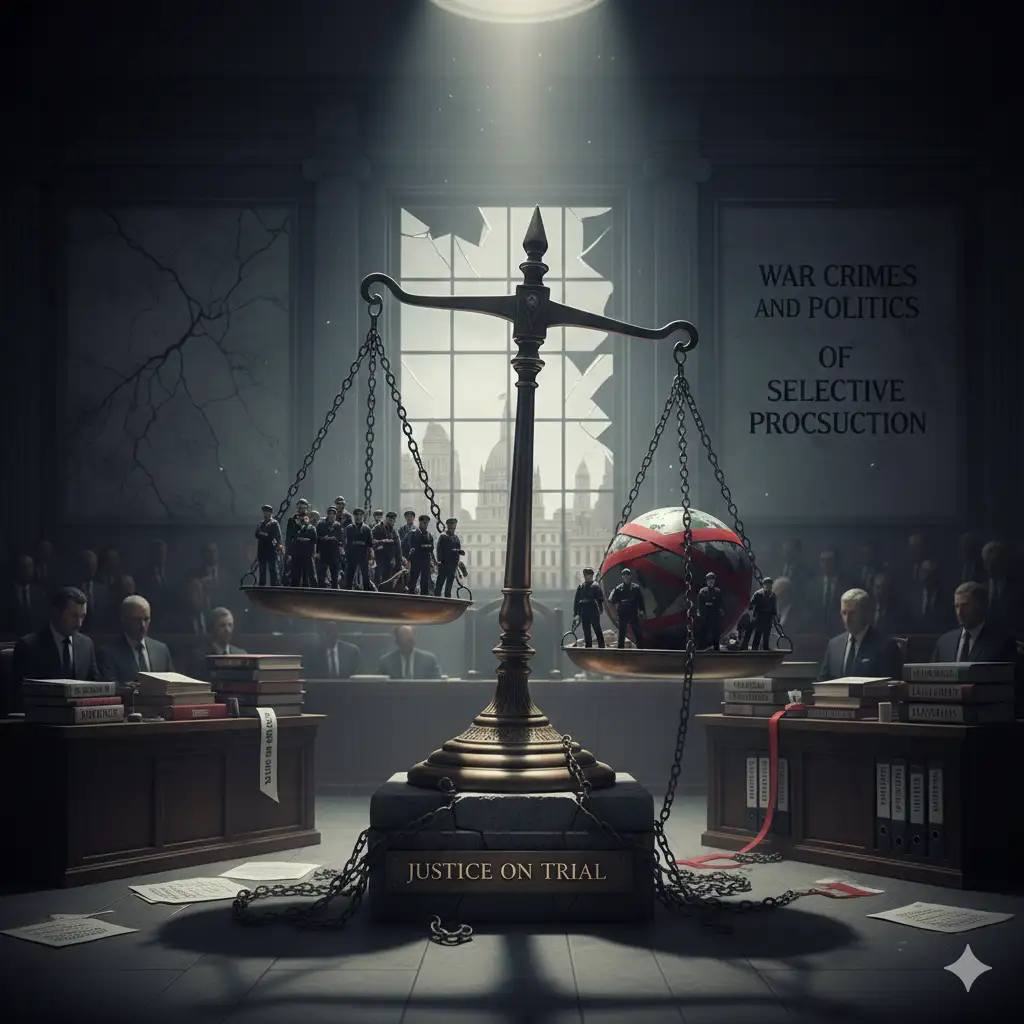
The 1949 of Geneva Conventions and the 1977 Protocols from the core of International Humanitarian Law, ratified universally mandating humane treatment[10]. The International Criminal Court as per the Rome Statute exercises the power of contemporary jurisdictions over genocides or crimes against humanity, war crimes, aggression or other extremist acts triggered by the state referral or prosecutor initiative[11]. The ad hoc tribunals set several precedents like the prospect of universal jurisdiction that promises the eradication of impunity through fair trials and victim reparations. Yet, power subverts promise. The Nuremberg or Tokyo incident embodied “victor’s justice” ignoring the firebombing, the aggressions caused by the Allied powers[12]. In several instances, Russia vetoes the United Nations Security Council referrals likely, the 2023 Ukraine’s warrant on child deportations, 2024 warrants on Gaza Strip starvation etc face several challenges regarding jurisdiction and enforcement[13]. It somewhat points a bias towards Africa likely, the pre-2023 dockets on Sudan or Kenya based fuels as western tool accusations while Kissinger evades Cambodia Bombings. Non-cooperation, vetoes and resource disparities shield the powerful nations like US, Russia, China etc resulting only in the prosecution of their weaker rivals.
CONCLUSION
War crimes are among the most heinous breaches of international humanitarian law, including, but not limited to, intentional killing of civilians, torture, forcible transfer, and employment of prohibited weapons. These crimes are defined under Article 8[14] of the Rome Statute of the International Criminal Court, which holds individuals liable, irrespective of their official status, to prevent such crimes from sullying human history, from ancient wars to contemporary genocide. Politics barges in, and suddenly, even the best rules get twisted. The world’s justice system only looks impressive on paper, but it tends to fold whenever the big powers decide they’re above it all. History doesn’t exactly hide this pattern. It started with the Lieber Code, rolled through the Nuremberg and Tokyo trials after World War II, and then spawned courts like the ICTY and ICTR. These tribunals did try some notorious war criminals from places like Srebrenica and Rwanda. They finally called rape what it really is a weapon of genocide. But if one thinks rationally, then one would notice that somehow the winners always seemed to get a pass. No one questioned or held the Allies accountable over Dresden. If justice only lands on the powerless, it stops being justice altogether. It turns into another weapon for the strong to use however they want. That destroys any real chance of stopping future atrocities, and tears apart the rules the world is supposed to share leaving places like Ukraine and the Middle East to pay the price. We can’t wait around for change. The United Nations Security Council shouldn’t be able to shut down cases with a simple veto. Countries need to actually prosecute these crimes at home. Treaties have to matter, and investigators need the freedom to follow the evidence wherever it goes not just to Africa. Justice can’t keep bending to politics. Real justice for war crimes can’t happen unless we overhaul the way the world prosecutes them. Right now, the system is built on things like the Rome Statute, Geneva Conventions, and those special courts set up for Yugoslavia and Rwanda that talks about holding everyone accountable. The double standard doesn’t just make the system look bad, but it allows more atrocities happen, because nobody fears real consequences. For instance, the Allied crimes at Nuremberg got swept aside, or at how current arrest warrants for leaders like Putin or Netanyahu are basically ignored. Fixing this means taking several steps at once. First, the UN Security Council needs to stop letting its permanent members block war crimes cases with a veto. Next, countries everywhere should expand universal jurisdiction. And money matters too. We need to fund investigations that look beyond Africa investigations that dig into economic harms, like the thousands of children who died under Iraq’s sanctions. Hybrid tribunals, the kind that mix local and international judges like in Sierra Leone[15], can help tamp down accusations of bias. And victims deserve more than words. Reparations funds, using assets from those convicted, should go directly to survivors, offering something real to people suffering from PTSD or forced to flee their homes in places like Syria or Gaza. At last, justice should put power on trial, not bow down to it.
REFERENCES
[1] International Committee of the Red Cross, 'War Crimes under the Rome Statute' https://www.icrc.org accessed 15 January 2026.
[2] Rome Statute of the International Criminal Court (adopted 17 July 1998, entered into force 1 July 2002) 2187 UNTS 90, art 8
[3] Instructions for the Government of Armies of the United States in the Field (Lieber Code, 24 April 1863); Hague Convention (IV) respecting the Laws and Customs of War on Land (adopted 18 October 1907, entered into force 26 January 1910) 187 CTS 227.
[4] Rome Statute (n 3) arts 1, 17.
[5] Nuremberg Judgment (International Military Tribunal, 1 October 1946) 41 AJIL 172; Prosecutor v Tadić (Judgment) ICTY-94-1 (26 January 2000).
[6] Prosecutor v Tojo (Judgment) Tokyo IMT (1948) in R John Pritchard and Sonia Magbanua Zaide (eds), The Tokyo War Crimes Trial (Garland 1981) vol 22
[7] Quincy Wright, 'The Law of the Nuremberg Trial' (1947) 41 AJIL 38.
[8] Prosecutor v Akayesu (Judgment) ICTR-96-4-T (2 September 1998); Prosecutor v Milošević (Decision on Preliminary Motions) ICTY-02-54 (2004).
[9] UNICEF, 'An Analysis of the Impact of the UNICEF Experience' (1991) https://www.unicef.org accessed 15 January 2026.
[10] Geneva Conventions (adopted 12 August 1949, entered into force 21 October 1950) 75 UNTS 31; Protocol Additional (I) (adopted 8 June 1977, entered into force 7 December 1978) 1125 UNTS 3.
[11] Michael Howard, The Laws of War (Yale University Press 1997) 12.
[12] James F Willis, Prologue to Nuremberg (Leipzig Trials 1921) (Greenwood 1982).
[13] UNSC Res 955 (8 November 1994) UN Doc S/RES/955 (ICTR); UNSC Res 827 (25 May 1993) UN Doc S/RES/827 (ICTY).
[14] Rome Statute of the International Criminal Court (adopted 17 July 1998, entered into force 1 July 2002) 2187 UNTS 90, art 8.
[15] Special Court for Sierra Leone, Statute (adopted 16 January 2002) https://www.rscsl.org accessed 15 January 2026.