Language Barriers and Systemic Exclusion from Access to Justice
Minisha Padhi
Harsh Tyagi
Akshita
Editor: Sakshi Soni
Abstract
The essence of access to justice is not merely in the availability of courts or even judicial procedures. Access to justice can be said to be real only when people are able to understand and participate in the said system meaningfully. In a multilingual society such as India, the question of language assumes significance regarding actual access to justice. The paper looks at how language barriers create systemic exclusion in the justice delivery mechanism, which inescapably affects the marginalized and underprivileged groups. This paper aims to establish that language barriers do, in fact, undermine the access to justice. It seeks to use doctrinal methods to study linguistic access in modern Jurisprudence. It acknowledges the importance of comprehension relating to procedural fairness, while identifying gaps in the current legal system that precludes a large number of people from being a part of it. This paper argues that judicial protection, although beneficial, can only do so much for inclusivity in the linguistic space, but the rest has to be implemented by the government and its organs. Further, it evaluates legal, institutional and administrative reforms that could be undertaken and suggests methods to implement the same. The paper also proposed to take a multi-layered approach to the issue at hand. The paper sets a strong case for why linguistic equality is an important component of equal access to the justice system, and critically analyses India’s linguistic landscape.
Introduction
Access to justice is the cornerstone of any democratic legal system, especially in the politically instable climate that seems to pervade 21st century. Every country in the world must possess a speedy and effective legal system available to its citizens, since it is a basic legal right which is integral to maintaining personhood and upholding justice. Access to justice, according to the United Nations, refers to the ability of people to seek and obtain remedies through formal or informal institutions of justice, in accordance with human rights standards.[1]It requires that the systems that govern the law in a country must be free, impartial and accessible to all.
In an ideal world, it is fair to assume that each and every person is included in the justice systems of a country, and can approach it with the utmost ease. However, this is not the case in most legal systems around the world. People, most often those living below the poverty line, face a deluge of issues relating to access to justice. According to a recent study, language barrier is one of the biggest hindrances to timely access to justice in India. Individuals who cannot read and write the predominant language used for legal communicates are conveniently excluded from the system, and thus denied access to justice.
Language plays a central and significant role in the legal system of any country. It is the basic unit of the law, without which it would not exist. Language is fundamental to legal systems, since the law operates almost entirely through communication and interpretation. The ability to understand legal rights and procedures is a precondition to availing justice, without which all the rights offered to citizens by the legal system become invalidated. Law and Language are extremely interwoven concepts that complement and uplift each other. This interconnectedness serves those who master the language, in which the law is written, extremely well. However, those who do not possess knowledge of this language, most often those in underprivileged regions lacking formal education; are excluded from the so called ‘inclusive’ legal system.
There is a huge difference between the realist view of the legal system, which our lawmakers and forefathers envisioned, and the actual, on ground, practical reality of the day-to-day working of the law. The prevalence of this issue, in the Indian legal system, and other predominant legal systems in the world, is what prompted the study that will follow. This paper,
through empirical evidence and doctrinal analysis, seeks to analyse the legal and human dimensions of linguistic exclusion, in relation with access to justice systems, particularly in people living below the poverty line. It also seeks to critically analyse the disconnect between inclusiveness of justice, and the ability of the legal system to cater to the diverse legal needs of the citizens in a country.
1. Conceptual and Theoretical Foundations of Access to Justice
1.1. Understanding Access to justice: Meaning and scope
Access to Justice refers to the ability of any person, regardless of their race, ethnicity or religion, to use the legal system to resolve their issues and advocate for their interests. Access to Justice, in its essence, is a tool to ensure social justice and preserve Human dignity. It is a basic principle of the Rule of Law.[2] In India, the Rule of Law assumes utmost significance, and so must a corollary of it, which is access to justice.
Before we understand access to justice, let us understand what justice actually means. Justice can actually connote different things to different people. What may be considered ‘just’ In one society may not be considered the same in another. In one way or another, however, justice always includes fair and equitable treatment to all human beings. Equitable and fair treatment of all people is the bedrock of access to justice. The issue begins when justice is not made accessible to all the people in a society, particularly those living below the poverty line.
This is precisely why the scope of access to justice extends beyond the courtroom and the constitution. The scope of access to justice includes the following dimensions- institutional access, procedural access, economic access and information and linguistic access. Arguably, information and linguistic access is the most crucial element of justice in any society. Legal rules and remedies are only meaningful when people can understand them. This scope is especially important in a country like India, where there is a dominance of an Elite language, English in this case, can exclude a large number of people from the loop. Ensuring linguistic access can strengthen equality before the law, and the legitimacy of the system in itself.[3]
In this paper, what we try to understand is not just access to justice, but more so, the ‘lack’ of access to justice. It is said that our justice system is only as strong as the weakest person it protects. This means that the people at the lowest rung of the ladder have to brought within the ambit of the justice system. Good justice systems are important to protect, promote and maintain the quality of life of its citizens, along with maintaining equitable levels of justice across all sections of the society. When the justice system fails, it is akin to the entire nation failing its citizens, since justice is the bedrock of democracy.
1.2. Language as a Component of Justice
Language does not just function as a tool for communication in legal proceedings; however, it goes one step further to facilitate the very idea of justice. In India, we have over 22 official languages and 121 other languages,[4] which are spoken by the 1.4 billion people that reside in the country. Thus, it seems very archaic that despite the immense linguistic diversity, courts often heavily rely on English and the state’s official language to conduct proceedings and issue documents. This creates a rift between the legal system and those who are automatically excluded from it due to linguistic disadvantages. It results in a gap between the legal system and those persons who are excluded from the legal system on the basis of some linguistic disparities. It is often seen that this gap results in a lack of awareness among persons about legal formalities, claiming rights, and taking part in legal court proceedings. It is therefore a crucial consideration to be addressed at the time of justice delivery.
The language barrier also raises questions about the relationship between language, power and law. This is evident through both procedural and substantive aspects of justice. Courts communicate either through oral or written methods of communication, expressions and references. Those who understand it are better positioned to navigate the terms of the law, and protect their rights. On the other hand, those who cannot interpret the language, are left at a significant disadvantage as compared to the former, often finding the system intimidating and inaccessible. Taking this into consideration, The Supreme Court, in State of Maharashtra v. Dr. Praful B. Desai (2003),[5] highlighted that comprehension of charges and proceedings is critical for the protection of rights, demonstrating that language plays a very critical role in the administration of equality and fairness in the modern society.
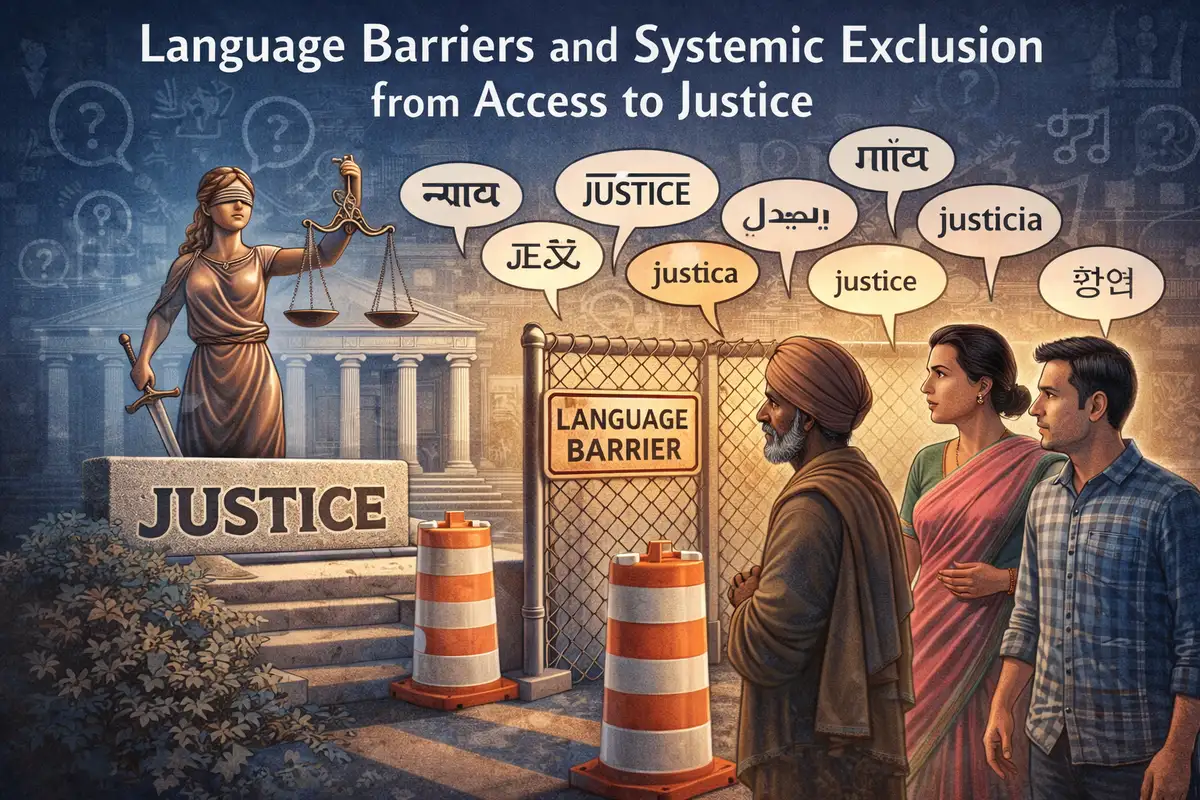
Not just linguistic barriers, Comprehension can also play an important role in the administration of justice. Legal rights cannot be guaranteed effectively to its citizens if individuals, although familiar with the language of communication, are left in the dark about the interpretation of the ‘language’ of the law. In India, studies show that linguistic minorities, migrants and tribal communities find difficulties in performing basic legal functions like filing petitions, following court proceedings or accessing legal remedies. This leaves the most vulnerable group of people out of the justice system, which is a major failure on the part of the government. In this situation, interpretation and translation services are necessary to foster inclusion. Making legal communication clear and accessible must be the main aim of the legal system, to ensure that justice is wholly administered.
1.3. Language as a Structural Barrier to Justice
System or structural refers to displacement and disadvantageous situations created by any institutions’ operational issues.[6] In the context of access to justice, exclusion does not happen intentionally, but occurs due to lengthy and complex court procedure, language barriers and the administrative systems. The problem arises due to ignorance on the part of the lawmakers. The processes are created based on a false assumption that each and every individual has perfect literacy levels, comprehensive ability and proficiency in the language. However, this is very far from reality. Assumptions like these conveniently exclude those marginalised people who do not fit into the ‘ideal’ profile of a citizen, rendering them helpless.
One such example of systemic exclusion would be linguistic exclusion. The constitution of India guaranteed equality and fair legal procedures under articles 14 and 21; official documents and court processes are predominantly documented in the English language. India’s 2011 census recorded that only about 10% of India’s population speaks English fluently, however English remains the predominantly used language of the judiciary.[7] Studies conducted in tribal areas have found that people in tribal areas and marginalised communities often have to use a third party to interpret the novel language, which greatly compromises the confidentiality of the legal process. Further, it may also hinder the information sharing process, due to fear of personal details being misused by the third party interpreting the law.
Therefore, language is a major structural barrier to accessibility of the law, especially among marginalised communities. Recognising the issue as a legitimate hurdle in the dissemination
of the law is the first step in the right direction. Rather than placing the burden on the population, the law-making institutions must take matters into their own hands and enact measures to this effect. Only by embedding linguistic inclusivity into the legal framework of our country, can the system become a genuinely all-encompassing and accessible justice mechanism, catering to the needs of all the people of this country.
2. Language Barriers in the Justice System
Language functions as the primary medium through which justice is administered, communicated, and understood Language serves as a major platform on which justice is delivered, conveyed, and comprehended. Starting from investigation to the ultimate stage of judgment delivery, all judicial systems are largely reliant on linguistic understanding. When a justice system functions largely in a major or dominant language, people lacking linguistic acumen in that language face a serious setback. Language barriers are a major influence in different levels of a justice delivery chain, such as judicial institutions, police investigations, and legal documents.[8]
2.1. Language in Courts and Judicial Proceedings
Courts normally conduct trials in a major language, which is official in nature, in accordance with a law. Although this promotes standardization in an organizational sense, it is quite oblivious to linguistic diversity among those before the law. A defendant, witness, or victim, for example, who cannot understand a language being used in court will not be in a position to follow the case being dictated against them, let alone give their version of a case.
In Hussainara Khatoon & Ors. v. State of Bihar,9 decided in 1979, the Indian Supreme Court reiterated that "The right to a fair trial is an integral part of Art. 21 of the Indian Constitution." A fair trial would include a defendant's participation in the case. A defendant's participation in a case will not be possible if he or she fails to understand the proceedings in a court of law because, if a defendant fails to understand a court proceeding in which a case is being conducted, such a defendant will not be able to participate in a manner which will make a case fair in content notwithstanding the fact.
Language barriers become more complicated when it comes to examinations and crossexaminations, where accuracy is critical. As stated in State of Rajasthan v. Darshan Singh in 2012,[9] inconsistencies in statements may arise not from intention to mislead but from a lack of understanding, thus emphasizing the need for accurate translation. The witnesses and victims can easily become non-credible when their statements are wrongly translated.
Decisions are normally couched in intricate judicial language, which is not amenable to understanding by commoners. In the case of Manubhai Ratilal Patel v. State of Gujarat in 2013, [10]it was emphasized by the Supreme Court that procedural justice is not complete without comprehensibility and understanding. A situation where people do not grasp the rationale for decisions impacting their rights is not a complete delivery of access to justice.
2.2. Language Barriers in Police and Investigation Stage
Language impediments during investigation may have a disastrous impact on justice being delivered. Cow police authorities usually jot down statements/alliances in fir statements, statements, and confessions in the official language, despite the fact that the informant/accused is not conversant with it.
In the case of Nandini Satpathy v. P.L. Dani (1978), [11]it was held by the Supreme Court that a right to self-incrimination contains the right to remain silent and against coercion during interrogation. If a person involved in a case does not understand the court’s language, they cannot understand the case against them or clearly present their own version.
Moreover, in State of Punjab v. Baldev Singh (1999), [12]it was further clarified that if procedural protects are not meaningful, they would become a mere fiction. The recording of confession statements without ensuring linguistic understanding puts a person under compulsion and leads to false confession statements, especially in the case of underprivileged people in society.
2.3. Language in Legal Documentation and Procedures
The legal documents are spine of justice, but they remain inaccessible because of their complicated formalistic language and non-availability of translation. The notices, summons, bail, and other procedural documents are ordinarily drafted in only in one language, which leads to procedural defaults for people speaking other languages.
Legal documents are an integral part of the judicial system. They can sometimes prove very tricky to read for common man. Most of the legal documents such as notice, summons, order for bail, and judicial forms are written in a way that is technical and very complicated. For a layman or a common man, these documents are bound to be confusing and even frightening.
In most situations, documents such as these are not available in regional languages. This can pose a problem for people who do not know how to read or speak the language in which they are written. people do not realize why they need to see a notice, when they have to appear, or what they are supposed to do. This also all cause them trouble at the end by indirectly not complying with court orders
The presence of technical terms in law further puts people who speak non-dominant languages at a procedural disadvantage. Even where they benefit from a law aid service, they largely have to rely on other people to clarify matters for them in law, which brings with it a possibility of misinformation or misunderstanding. A lack of proper communication deters people from accessing law and gives them a sense that justice is not accessible.
Hence, the lack of simple vocabulary usage in legislation and translated legislation functions as a hindrance to justice. This is because, instead of being a tool to aid people in claiming their rights, a legislation document can be an additional impediment to people with limited language capabilities.
3. Constitutional and Human Rights Foundations of Linguistic Access to Justice
Language plays a crucial role in ensuring access to justice.
4.1. Constitutional Provisions
The right to equality before law under Article 14 of the Indian Constitution means that everyone should be treated fairly by the legal system
4.2. Criminal Justice and Procedural laws
The Indian criminal law holds safeguards that prevent the victim/accused from being treated unjustly because of language problems. One of these rules may be summed up by the fact that the suspect must be able to understand the charges being laid against him or her. According to law, the suspect must be told the charges against them in a language they can understand. This means that the court should offer the service of interpreters whenever the suspect or the witnesses involved in the case fail to comprehend the language used in court. This right makes the understanding of the legal system and the individual’s understanding meet at a common ground to ensure the participation of the individual in the justice system is effective. Legal aid, guaranteed by the Constitution under Article 39A,[13] is also a critical factor in countering the challenge of exclusion based on language. Free legal aid ensures that the economically and socially disadvantaged have legal representation. It has, however, been noted that providing legal aid may not necessarily be enough if there exists a possibility of the accused not being able to understand the lawyer because of differing languages.
4.3. Human Rights Perspective
The right to language in international human rights is strongly acknowledged within the concept of a fair trial. The Universal Declaration of Human Rights (UDHR) and the International Covenant on Civil and Political Rights (ICCPR) are a couple of examples that include a fair trial in its principles. One such international document explicitly mentioning the right to interpretation and translation in criminal matters is the ICCPR. According to the ICCPR, “Everyone charged with a criminal offence has the right to be informed promptly and in detail in a language which he understands of the nature and cause of the accusation against him. Everyone shall have the right / free assistance of an interpreter if he cannot understand one of the languages employed in the proceedings.” [14]These provisions address the fact that language is not just an afterthought or minor procedure, but instead is instead very important to individual human rights. In recent years, rights over language have increasingly been acknowledged as human rights since there is a close nexus between rights and dignity. Denial of rights over language translates to denial of exclusion, dignity, and equality. On this account, it can be argued that both constitutional and human rights law place an obligation on governments to overcome this significant barrier to access to justice.
4. Judicial Analysis of Relevant Case Laws
4.1. Judicial Recognition of Language and Fair Trial Rights in India
Indian courts have held in the past that a fair trial is an essential part of access to justice. Language barriers may not be addressed as the main issue; however, multiple judicial decisions have emphasized the concept of linguistic equality in the past. It is observed that if a person is not able to comprehend the language used in courts and legal document, their involvement in
the legal system becomes highly restricted, which is problematic for the country at large. The Supreme Court, In the case of Maneka Gandhi v. Union of India (1978),[15] held that all processes that any procedure affecting personal liberty has to be fair, just and reasonable. The judgment rendered in this case can be extended to apply to linguistic barriers and access to justice and also lays the foundation for procedural fairness. The rationale behind the judgment is to have more inclusive laws surrounding personal liberties, and in the case of linguistic barriers, to make the justice system fairer and more accessible to all sections of our society.
Furthermore, the importance of language parity has been recognised in various criminal cases. In Hussainara Khatoon v. State of Bihar (1979), the Supreme Court linked access to justice with the plight of undertrial prisoners in India, who are often poor, illiterate, and most times unaware of the legal procedures. It was in this case that the Supreme Court held that the right to a free and fair trial is an essential part of Article 21 of the Indian Constitution. Similarly, in the case of D.K. Basu v. State of West Bengal (1997), the Supreme Court emphasised, among other things, that those who are arrested must necessarily be informed of their rights. This case highlights that clear and timely communication of a person’s rights is an essential legal requirement and necessary to promote legal awareness and equality in access to justice. These principles were further espoused and elaborated in later case laws like State of Maharashtra v. Dr Praful B. Desai (2003), [16]which made it necessary and mandatory for accused to be made aware of the nature of the proceedings.
Multiple judicial observations have been made by the courts, which emphasise the importance of using comprehensible legal language. In the case of State Bank of India and Ors. V. Ajay Kumar Sood (2022), [17]Justices D.Y. Chandrachud and A.S. Bopanna observed that the decision given by the Himachal Pradesh High Court is ‘incomprehensible’ and must be written in an easy-to-understand manner, avoiding complex jargon as much as possible. In some instances, the judgment has been unnecessarily long and complicated, like in the case of Surjeet Singh and Ors. V. Sadhu Singh and Ors. (2018),[18] where it was held that the impugned order issued by the High Court did not need to be 60 pages long and was directed to be made shorter. This is a step in the right direction since people shiver at the sight of long and complicated judgments and give up before even giving the judgment a glance. To prevent this fear, it is imperative to
use clean, simple language, which allows people from all social strata to get an opportunity to learn about their rights and remedies. Such cases and judicial decisions show that Indian courts are increasingly recognising the importance of making judgments easy to comprehend, which ultimately reduces the isolation of people from the legal system and mitigates language-related legal barriers, especially to the underprivileged class in the country.
4.2. International Case Laws: Linguistic Access and Fair Trial Standards
International courts have consistently recognised language comprehension as an important component of equal access to justice. Often times, language barriers are treated as administrative and procedural issues. However, International Law views linguistic barriers from a novel perspective. It suggests that linguistic access is a substantive right closely linked with dignity, equality and due process of the Law. This principle is strongly enshrined in the International Covenant on Civil and Political Rights (ICCPR). Article 14 of this law states that there must be fair trial and equality before all courts.[19] It requires that a person be informed of their charges in a language that they are able to understand, and provide any additional help if needed. This ensures that the law does not become an isolated concept, distinct from the society and highlights that laws derive their value from their ability to be comprehended. Another International law to this effect is the International Criminal Tribunal for the former Yugoslavia (ICTY),[20] which held that an accused cannot be held in custody without being able to defend themselves in court. This was done to foster proper, clear understanding of the law, especially among those who feel like they do not have a voice, making the legal system open and transparent. Similar standards are enshrined in Human rights instruments in International Law. Article 6(3)e of the European Convention on Human Rights (ECHR) guarantees free interpretation services to those who cannot understand and speak the official legal language. [21]The focus is not just on translation services, but on the broader impact this law has on bringing about accessibility in the justice system. Principles enshrined in the Rome Statute of the International Criminal Court (ICC) and other international law bodies ensure that linguistic access is treated with utmost primacy in the legal systems of countries. These principles, if adopted in India, would greatly change the landscape for the access to justice, making it more equal and meaningful.
4.3. Critical Evaluation of the Judicial Approach
Indian courts have delivered progressive judgements, recognising the importance of language in the process of access to justice. Through interpretations of Article 14 and 21 of the Indian Constitution, the judiciary has noted that access to justice is a fundamental principle of equality, hence must be protected at all costs. Notably, the Supreme Court has translated over 42,000 judgments into 17 regional languages by late 2024, to encourage judicial transparency. [22]Certain High Courts also started conducting proceedings in Hindi, although widespread implementation still remains inconsistent. Various case laws that have been interpreted in favour of fair trial rights and informed charges to the accused, have played the critical role of setting down the foundations for a more linguistically equal system.
Nevertheless, there is a huge disconnect between what the government and courts claim to do, and what they actually do in real time. The rules on linguistic barriers are only considered on a case-to-case basis as they are not binding on those flouting the norms. Lower courts, where legal interpreters are needed the most, are falling short of translators to help with translation and understanding, thus undermining the very purpose access to justice. Further, courts do not exercise complete control over linguistic accessibility, since it is not binding on any government body to follow the guidelines. The people who are affected the most by this are those who cannot afford to fight, or have lost too much time to a system that does not reward them.
Other problems exist as well: legal documentation is hardly ever written in the local language, and issues like poverty, low literacy and caste factors all contribute to the inefficiency in the justice system. Efforts by NALSA and state legal aid groups provide assistance in offering interpreters and translators, however the efforts are too little and scattered to quantify into measurable change.[23] However, this issue needs to be resolved as over 90 % of the people in the country are excluded from the justice system, solely due to linguistic barriers.
There is only so much that a court can do to bring more people under the ambit of its judgements. Linguistic barriers, however, hinder any progress made by the judiciary for the welfare of people excluded from the system. Judges cannot enforce widespread interpreters and multilingual materials across a state or a country. Matters of such large scale can only be
implemented by the Government through executive state action. Although the judiciary has been working towards dissolving linguistic barriers and bringing more people into the justice system, more efforts in the direction of court oversight, new rules and better resources is required. Without these reforms, people will continue to live in blatant ignorance of the law and access to justice.
5. Systemic Shortcomings and Implementation Gaps
Despite the acceptance of the importance of language access for justice by the law, there exist several issues with the application of these provisions in real life. People continue experiencing difficulties in courts because the system lacks strength, there is a lack of resources, and the system is not lenient enough for people to benefit from language rights in reality.
5.1. Limited Supply of Qualified Interpreters
One of the major issues facing the justice department is the lack of professional interpreters. Most courts, especially at the district and lower levels, are oblivious to qualified interpreters or cannot accommodate the required number. Because of these reasons, courts have to rely on ad hoc arrangements where court employees or police personnel act as interpreters, who may not possess ample language skills. The other quality of interpretation is the problem. Legal proceedings involve technical terms and serious consequences. If an interpreter has not undergone proper training, he may fail to catch important information or translate it incorrectly. This can directly impinge on the outcome of a case and thus affect the rights of the accused or the witnesses. There is also a lack of uniform training and certification in place for court interpreters. India does not have a standardized way of training, deploying, and supervising interpreters in courts. Without proper standardization, the quality of interpretations tends to be erratic, thus marred with inequalities in the justice delivery process.
5.2. Institutional and Administrative Failures
But institutional failures further worsen the problem. One major reason is financial constraints. Interpreters, translators, and multilingual assistants cost money. These are low priorities in large budgets. Most courts cannot afford to employ professional language experts. There is also a lack of awareness among judicial and administrative officials. Many officials do not acknowledge a language barrier as a problem that seriously affects justice. In many cases, the responsibility to request interpretation is placed on the accused, who may not know that such a right exists. This leads to silent exclusion rather than active protection of rights.
5.3. Procedural Inflexibility
Procedural rigidity plagues the justice delivery system. The over-reliance of courts on a single dominant language, usually English or the official state language, even in cases where none of the parties understands that language, ignores India's linguistic diversity. The courts are commandingly inflexible to meet the needs of marginalized groups. Forms, judgments, and proceedings rarely, if ever, are available in local languages. It is this rigid approach that acts as a barrier rather than a force to remove them and makes access to justice difficult for large sections of the population.
6. Proposed Reforms and Policy Measures
6.1. Legal and Policy Reforms
Effective legal and policy reforms are essential to address the language barriers that plague our justice system today. Despite constitutional recognition of linguistic disadvantages, most of the verdicts and judgements given by courts are delivered in the English Language, rather than the native language of the state, making it extremely difficult for underprivileged and illiterate people to comprehend the law. This creates systemic exclusion for a huge section of the population, often to those who need reforms the most. It has been recognised that through Articles 14, 21 and 39A,[24] 26the law guarantees equality and fair trial processes, however, these rights lose their power when they are not properly implemented in the justice system.
This is precisely why reform measures are necessary to help keep the system in check. A primary measure of reform must be to provide mandatory interpretation services to courts and government offices at all levels. Although this mechanism already exists, it has not been implemented in an efficient manner. This is true especially in the subordinate courts, where the lack of interpreters can lead to lack of fair trial due to undue influence by the party that is able to understand the language. Hence, it is important to provide such services, to augment the comprehensive abilities of those living along the margins.
Anything that is not enforceable in a court of law is bound to be ineffective in a social setting. That is why it is necessary to make interpretation services and translations as a mandatory requirement, or a statutory obligation. This is because, unless there are consequences to flouting linguistic barriers, it will continue to occur on a larger scale. These services should not just be
limited to the courtroom, but also extend beyond it, including police investigations, remand proceedings, legal aid consultations etc.
Apart from interpretation services, it is also important to change the language used in the law. The constitution has to permit the use of regional languages, atleast in the lower judiciary, to facilitate linguistic equality. The procedural laws have to be framed to make them more inclusive to multiple languages. Legal scholars emphasise that most of the legal documents, and other government documents in general remain largely inaccessible to a huge section of the population, due to apprehensions about the language in which they are written. Although the constitution does permit the right to present documents in the regional language, this has not been properly integrated into the justice system. It is the onus of procedural laws to mandate charges, notices and essential court orders to be communicated in the native language, along with the language of the litigant, so that there are no disadvantages in understanding the law. Legal and policy reforms must be carried out with the main objective to foster inclusion in terms of language, and a broader vision of improving the justice system’s accessibility.
6.2. Institutional Reforms
Institutional reforms are essential to address the language barriers that currently exist in the legal system. Although constitutional guarantees for the same do exist, along with judicial recognition of such rights, it is important that they are effectively implemented by a legal institution. Although rights can guarantee a normative framework, what they cannot do it to implement the law themselves. This is when the institutions come into the picture, playing a crucial role in the on-ground implementation of linguistic equality. Two key issues that require urgent action in this sphere are the reforms in training mechanisms for judicial representatives, and the appointment and execution of interpreters.
The training of judges and lawyers in linguistic sensitivity is extremely important, since they are the pillar of the legal system. Studies show that most judicial officers operate under the false assumption that performing formal compliance is enough to ensure fairness in the system. However, it is much beyond just case files and documents. Without an awareness of how language can affect the comprehension and outcome of a decision given by the judge, such procedural safeguards may fail to protect the dignity of the process. To solve this issue, a structured training programme must be introduced in the judiciary to sensitise judges and lawyers to the impact that linguistic disadvantage has on individual seeking justice from the system, and how it disproportionately affects the marginalised class of people. The training should also include courses on certain regional languages, and the importance of translation services in the courtrooms.
Institutional reform must also include the appointment of certified interpreters. Although this has been gaining momentum in certain courtrooms across the country, it has not been widely implemented to encompass those who need such translation services the most. A Supreme Court report on district courts in India found that only 2.8% of district courts have certified interpreters and translators, underpinning the severe lack of interpreter services in India.[25] Most of these interpreters are ad hoc, who already work in the courtroom as staff or police personnel. This practice is highly concerning since there may be issues surrounding neutrality and confidentiality. Certified interpreters are essential at all stages of the judiciary to prevent linguistic mismatches in the legal system.
6.3. Technological Reforms
Technological and administrative reforms play a very important role in addressing access to justice and linguistic barriers, particularly in a country like India which has a rich and diverse cultural background. While legal and institutional reforms are important, it is also important to leverage the digital age and use it to enhance the efficiency of the system. Digital technology is also much cheaper and more cost effective as compared to traditional court translators. Two key areas that fall under the ambit of technological reforms would be use of digital translation tool and provision of multilingual legal aid apps.
The adoption of translation technologies will positively change the landscape for legal interpretation in our country, significantly reducing linguistic exclusion in the country. Digital platforms, e-courts and online management systems form the backbone of the judicial system in our country. However, most of these systems, although they do function, function predominantly in English. Most legal scholars have noted that if this issue persists, then there will be major communication gaps, excluding the most marginalised communities in our country. To solve this issues, digital communication tool must be effectively leveraged to prevent language barriers. However, automated tools must be used with caution, since they can also bring with it multiple legal and implementation issues along with it. Digital tools like AI
are also not always accurate, and can lead to mistranslation, leading to destruction of the whole purpose of using these tools to bring about justice.
A further reform measure lies in the development of mobile apps and digital tools. Such multilingual legal aid apps can help provide explanations for legal interpretations, bringing the law to the doorsteps. This initiative can greatly help people in the marginalised communities who feel helpless against the system.[26] Such applications can also be inclusive to the disabled communities, who are not able to access the justice system since it is not a conducive environment for them. Such applications can also help connect people, especially those in villages, to a nearby legal clinic or a court. These apps are extremely important as they facilitate connection to the legal system even without physical proximity or monetary resources. However, the use of such apps must also be exercised with restraint, since data protection and offline connectivity are roadblocks. Overall, digital tools can be leveraged to their full potential to better serve diverse linguistic communities, helping them connect to the justice system.
7. Conclusion
Language is a primary need for justice to be achievable. When citizens are not able to comprehend judicial processes, laws, and procedures, justice appears to be far away from them. The above arguments have demonstrated how issues concerning a different language are systemic and are produced within the system. Despite the provision being guaranteed through the constitution, language issues continue to affect people through exclusion arising from the lack of language services in courts, police stations, and judicial processes. Marginalized groups, foreigners, as well as the poor, who might suffer from language issues compounded by poverty, illiteracy, and ignorance, are most affected. Realizing equal access to justice would thus involve changes that exceed recognition in legal frameworks. What is apparently called for in the current context is the provision of interpreters, language-inclusion processes, awareness, and the use of technology. In conclusion, ensuring language access is critical to the rule of law, protection of fundamental rights, and building public trust and confidence in the justice system. Unless these barriers are removed, the promise of equal justice will continue to ring hollow.
References
[1](https://www.un.org/ruleoflaw/thematic-areas/access-to-justice-and-rule-of-lawhttps://www.un.org/ruleoflaw/thematic-areas/access-to-justice-and-rule-of-law-institutions/access-to-justice/institutions/access-to-justice/).
[2] U.N., Access to Justice, https://www.un.org/ruleoflaw/thematic-areas/access-to-justice-and-rule-of-lawhttps://www.un.org/ruleoflaw/thematic-areas/access-to-justice-and-rule-of-law-institutions/access-to-justice/institutions/access-to-justice/
[3] Mauro Cappelletti & Bryant G. Garth, Access to Justice: The Worldwide Movement to Make Rights Effective, 3–5 (1978)
[4] The Int’l J. of Legal Discourse & Advances in Legal Research, India’s Linguistic Diversity and Access to Justice
[5] State of Maharashtra v. Dr. Praful B. Desai, (2003) 4 SCC 601
[6] Singh, S. and Tomar, V. (Year) Language as a Structural Barrier to Justice.
[7] United Nations Development Programme (2018), Access to Justice for Indigenous and Tribal Communities.
[8] International Covenant on Civil and Political Rights art. 14(3)(a), Dec. 16, 1966, 999 U.N.T.S. 171 9 Hussainara Khatoon (I) v. State of Bihar, (1980) 1 S.C.C. 81 (India).
[9] State of Rajasthan v. Darshan Singh, (2012) 5 S.C.C. 789 (India)
[10] Manubhai Ratilal Patel v. State of Gujarat, (2013) 1 SCC 314 (India).
[11] Nandini Satpathy v. P.L. Dani, (1978) 2 S.C.R. 608 (India)
[12] State of Punjab v. Baldev Singh, AIR 1999 SC 2378
[13] Constitution of India, art. 39A (as amended 1976)
[14] ICCPR, art. 14(3)(a), Dec. 16, 1966, 999 U.N.T.S. 171
[15] Maneka Gandhi v. Union of India, (1978) 1 S.C.R. 248 (India)
[16] State of Maharashtra v. Dr. Praful B. Desai, AIR 2003 SC 2053
[17] State Bank of India & Ors. v. Ajay Kumar Sood, Civil Appeal No. 5305 of 2022 (Supreme Court of India,
Aug. 16, 2022) (MANU/SC/1040/2022; 2022 SCC OnLine SC 1067)
[18] Surjeet Singh & Ors. v. Sadhu Singh & Ors., AIR 2019 SC 406
[19] International Covenant on Civil and Political Rights, art. 14, Dec. 16, 1966, 999 U.N.T.S. 171
[20] Statute of the International Criminal Tribunal for the Former Yugoslavia, S.C. Res. 827, U.N. SCOR, 48th Sess., U.N. Doc. S/RES/827 (1993)
[21] European Convention on Human Rights, Nov. 4, 1950, 213 U.N.T.S. 221
[22] Supreme Court goes multilingual: 42,500 judgments translated using AI, IBTimes India (Dec. 20, 2024), https://www.ibtimes.co.in/supreme-court-goes-multilingual-42500-judgments-translated-using-ai-876800
[23] National Legal Services Authority (NALSA), Homepage, NALSA, https://nalsa.gov.in/
[24] Constitution of India, art. 14 26 Constitution of India, art. 21
[25] SC report on district courts: Just 2.8 % have sign-language interpreters, 6.7 % toilets female-friendly, ThePrint, https://theprint.in/judiciary/sc-report-on-district-courts-just-2-8-have-sign-language-interpreters-6-7https://theprint.in/judiciary/sc-report-on-district-courts-just-2-8-have-sign-language-interpreters-6-7-toilets-female-friendly/1898942/?utm_source=chatgpt.comtoilets-female-friendly/1898942/
[26] From tribals to labourers, legal help in local lingo through interactive apps; law must speak every language: Justice Surya Kant, Times of India (Aug. 3, 2025), https://timesofindia.indiatimes.com/india/from-tribals-tohttps://timesofindia.indiatimes.com/india/from-tribals-to-labourers-legal-help-in-local-lingo-through-interactive-apps-law-must-speak-every-language-justice-surya-kant/articleshow/123071289.cms?utm_source=chatgpt.comlabourers-legal-help-in-local-lingo-through-interactive-apps-law-must-speak-every-language-justice-suryahttps://timesofindia.indiatimes.com/india/from-tribals-to-labourers-legal-help-in-local-lingo-through-interactive-apps-law-must-speak-every-language-justice-surya-kant/articleshow/123071289.cms?utm_source=chatgpt.comkant/articleshow/123071289.cms